Friday, December 16, 2022

Final Blog Post

Well, here we are at the end. This blog and my previous assignments already contain a great deal of my reflections on the class content as a whole, but more than anything, this class has taught me how much more complex and multi-faceted film theory is than I ever thought it could be.

I really thought film theory was more-or-less the same thing as film analysis. Just watch the movie, and use your five senses to pick out all of the details you can, and then pick out what those details are doing to support the themes of the film. I had heard of "feminist film theory", "post-colonial film theory", but I, and I hate to say this but, I really thought that that was kind of like getting a group of feminists together to apply their feminist philosophy to film, without considering the storytelling abilities and technological aspects (strengths and limitations) of the medium itself. Basically, I thought feminist film theory was all feminism with very little film.

However, I discovered—through reading through Film Theory: The Basics, witnessing the complexities of the many gazes through Laura Mulvey and bell hooks, and having our own class discussions—that each splitting branch in the tree of film theories is only more and more in-depth in terms of the broader context its applying. You can't just know a little film theory and a little feminism to know your feminist film theory, you need to know both and you need to understand them well if you're going to be able to keep up with their analyses as well as their thesis claims/overarching purpose.

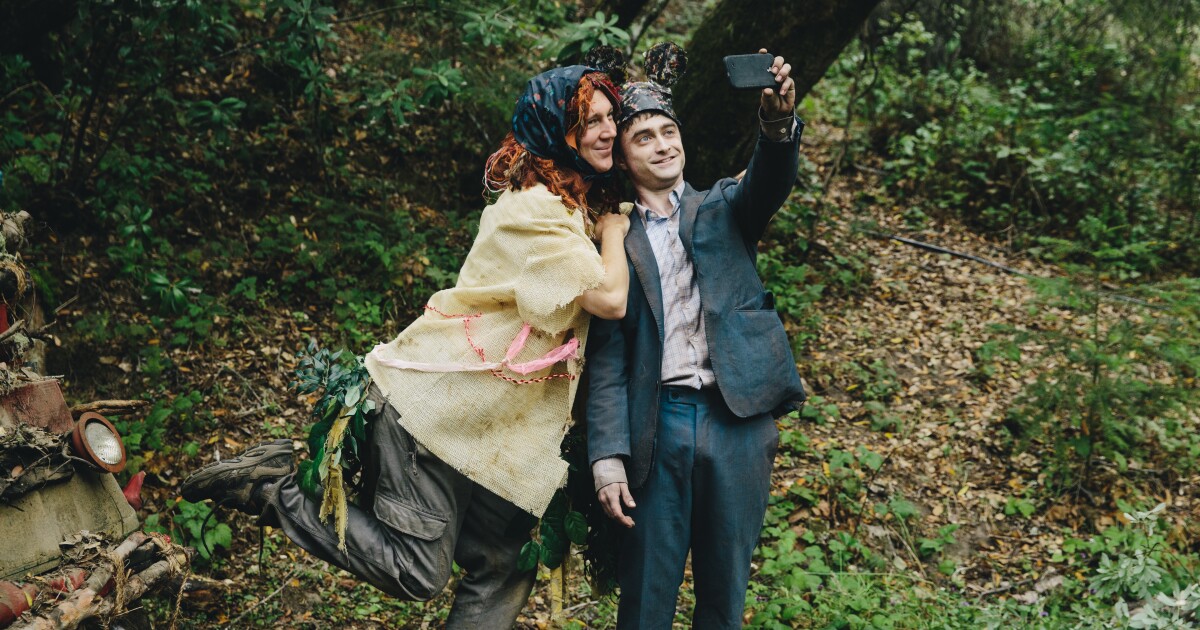
Similarly, I thought I knew what to expect from post-modern cinema. I know the tropes, you know the tropes, of course the directors are gonna know the tropes, and now we subvert them. Simple as that, right? Wrong again! There's so much more there to play with than just what the audience thinks they know. Sometimes it's not about making the viewer question what they can predict, but question what they're feeling. My experience with Swiss Army Man made me realize that there's no right emotion to feel when watching a movie, and that's part of the magic too.

The Film Story Narrative was a challenge for me at first. I couldn't find a single lovely memory among all of my cinematic experiences, just depressing or untellable stories. And as we discussed in class, that's maybe just part of human nature and what a "cinematic moment" represents. But when I finally found what I wanted to tell it was fun, and having to restrict myself to only a fraction of the length I would have made it otherwise made for an interesting and provoking challenge, which I think helped me hone in on my writing skills a bit more.

I already did a full reflection on my Fascination Project but that was a similar case of having a hard time finding my topic/purpose/goal, but upon finding it, being able to make a presentation I ended up being very happy with.

I thought we had an excellent class size and vibe, and the nature of discussion felt casual but focused. I wouldn't have changed anything about the class in that way, and I'm glad Professor Kyburz was our professor because I don't think anyone else could have taught it with as much starry-eyed passion and motivation. Sometimes when we got a little off-topic, it was just as insightful.

I'll truly miss coming to this class on Tuesdays and Thursdays, and I hope everyone enjoyed this class as much as I did.

Bad Things make for Good Films

When we first watched Breathless as a class, I didn't know what to think of it. With everything and nothing going on all at once, I was desperately searching for something to cling onto for grounding to understand what the film wanted from me, damn it! But the first thing that caught my attention in our class discussions was the fact that so much attention was drawn to Michel's sexism and overall poor character. I was a bit confused. Isn't that the whole point? He's supposed to be an asshole, clearly. At the time I wanted a second viewing of the film to make sure I wasn't missing something, but when I did watch it again, I found that I felt the same way.

Then I realized that the difference between me and some of my classmates might be what our expectations were in the first place. If you're going into the film with an explicitly feminist lens, then yes, you're sure to be disappointed by Michel. I think it would be quite hard to argue that he himself exudes any ounce of feministic energy, although one could argue his contrast to and somewhat submissive relationship with Patricia might. Either way, Michel himself was behaving in a way that demands no respect or admiration from the audience whatsoever. Unless you really are a sexist pig, I guess.

But my point is, the "protagonist", if you want to call him that—you could make the argument for him and/or Patricia, but he's seemingly the primary perspective—of this film is not meant to be someone we look up to or try to emulate. This is in heavy contrast to most film leads at the time, like the characters of Humphrey Bogart himself, perhaps an intentional nod of irony for Michel. 

Nowadays we are much more accustomed to "gray" protagonists, but often this grayness is reserved to the realms of violence and respect/disrespect. Anti-hero leads are allowed to be rude and they're allowed to shoot basically anyone but their companions, but that's the extent of their difference from the regular heroes, other than maybe flirting with the villain's side every now and then. To stay an anti-hero who's not just a regular good guy, they have not do too many good things, right? And to stay an anti-hero and not go full villain, they have to abstain from just as many bad things as good things. Sure, it is technically less generic to be an anti-hero when we're still coming down from countless decades of straight of pure heroism during the mid-20th century, when much of cinema was fully encoding itself into the pop culture. But does it actually make them more interesting to be the way they are, or is it just to be different for the sake of being different?

The entire spectrum of good to evil should not be so easily expressible in a simple Venn diagram. 

What is much more interesting to me is a gray protagonist who is impactfully flawed. To me, a good film will represent reality for what it is, not for an ideal. And even the heroes in our lives do things that are harmful to us in impactful ways. We might love our parents, partners, or closest friends, but most of us also have memories of their worst moments, when they were truly awful people even if just for a minute. Those parts of their "story" are real too, and it doesn't make them into villains.

Telling a story is impossible when you try to tip-toe around ever making someone do something legitimately bad. A character's worst actions shouldn't read to the audience as excusable. They shouldn't be "acceptable", but we also should appreciate the film for showing us that, not cancel it. I worry sometimes that the newest generation is being brought up to believe that if we see something bad, that that in itself is bad, and that's simply not the case. Knee-jerk reactions are always going make people feel strongly, and that's often the very intent of the film, yet people often blame the film for showing them something so "wrong" and "endorsing" it, when in reality the filmmaker's intent is probably the exact opposite of that. Cinema is a great place for us to explore the darkest parts of our collective human nature too, and to experience it in a safe and contained way while still showing us a reflection of what it might be like to experience such a thing in reality.

We should have more bad-but-not-evil people in cinema, because that's how it is in the world we actually live in.

Chapter 3 Questions

How does cinema reinforce the dominant ideology?

Cinema, by being a medium of the masses, is also governed by the masses. The dominant ideology of a society perpetuates itself through things like film. People, especially those who aren't film theorists, are attracted to films that they can relate to and tend to be pleased when their pre-existing ideologies are reinforced rather than challenged. As a result, the industry rewards feeding the dominant ideology rather than fighting it.


Why do so many stress the importance of developing counter-cinema? What are some examples of counter-cinema and how does it engage the viewers differently?

Because they realized the power and influence that cinema has, and how it was (and continues to be, to a degree) used as a way to reinforce pre-existing inequality. "Film theory during the 1970s and 1980s became increasingly concerned with the relationship between moving images and socially structured forms of inequity." (McDonald 101).

Avante-garde is a good example of counter-cinema, basically being counter-cinema by its definition of being different. Art house films, as I often hear them referred to, fall under this umbrella as well and have become very popular among film-lovers in the last couple of decades because they offer a contrast to the monotony of mainstream cinema.


Why do theorists draw attention to how specific groups are represented on film? How do viewers relate to these representations? How do some viewers challenge these images? 

Whether it is done properly or not, representation in film is a major aspect of how our the different groups within our culture have learned to view each other, especially in how they are similar to and/or different from each other. Thus, representation in film is extremely powerful and can shape both the perceptions of outsiders and people inside the group that is being represented. We as viewers relate to those who are similar to us in whatever aspects we can perceive, but we also tend to shy away when groups are depicted in a way that they are "the other". These kind of "othering" representations create prejudice towards these groups. This is why challenging pre-existing bad representation with good representation of minorities and disenfranchised groups is so important: it can create understanding and empathy where it might not otherwise exist.


Why did Laura Mulvey's essay have such an immense impact?

Mulvey essentially theorized and popularized the theory of the male gaze, which would go on to form a major backbone of the feminist film theory response to the overabundance of male gaze shots and films. She gave a name to a phenomenon that most women sure had felt for years but never had the proper terminology or framework to discuss it. "Mulvey's essay provided feminist film theory with a watershed moment." (McDonald 117).

Swiss Army Man Part 2: Intimacy with the Dead

Honestly, so many different wacky things happened throughout the rest of Swiss Army Man that is was sometimes hard to keep track of it all. With the slightly-convoluted plot of Manny believing he has a wife and a happy life, I totally believed it. Maybe I was supposed to notice that it was Hank's phone from the get-go, but if I was, I totally missed it. I only question whether I was supposed to know or not, because the "reveal" to Manny that this is the case is not treated as seriously as I might have expected if I already knew. Still, the twist is just as strong despite being treated in a rather understated manner, and it also made me realize just how sad of a character Hank is meant to be.

Hank and Manny both have a lot of heart and soul. They both care about other people and especially, by halfway into the film, about each other. Radcliffe and Dano are very convincing in their friendship, talking very much like real friends, not "this is the movie trying to tell you that these two characters are friends." I think their performances were crucial to this emotional heart of the film. And in turn, this emotional core is the main reason the movie succeeds.

Aside from all of the times that Manny's powers help them both in a way that is very touching, this emotional core is best exemplified in the scene where Hank pretends to be Sarah. The way this entire scene is shot is dreamy and almost psychedelic. We feel as lost in the moment as they do. Since we know Manny doesn't understand much, we allow ourselves to believe that Hank with a wig is just as beautiful to Manny as the real Sarah would be in that moment. We know that it's about what Hank represents, not what he actually looks like in that moment.

Some people would argue that this scene is "gay". And of course if it was, that would be fine too. And certainly, it doesn't shy away from allowing Hank and Manny to have some sort of ambiguously romantic intimacy in the special moment, when the audience is placing themselves in Manny's imagination. And actually, this gay/not-gay theme is played with again later in the film when Hank kisses Manny for air, but he like MAKES OUT with Manny for it, probably just because he needs the most air but again, it leaves room open for interpretation.

However, I also think that this scene is meant to show their strong love for each other in general, not in an inherently romantic sense of course. Especially Hank's love for Manny in this moment. For most men, putting on a wig and acting like a woman is obviously and inherently pretty emasculating. It can be an uncomfortable and insecure feeling. But we see that Hank allows himself not only to be vulnerable for Manny's sake in this way but also to allow himself to be the subject of Manny (a dead man!)'s fantasy because he knows how much it would mean to Manny. Dano does a great job by actually physically acting the part of a loving companion. He acts very girlfriendy, leaning on Manny romantically. It legitimately cute and it adds to the comedy of the film of course, too.

He's not reluctant, he really wants Manny to feel what love is like. Maybe because Hank wants that so much himself, too. He's being the Sarah of his own fantasies. He is doing all of this because he knows it'll bring a dead man a little bit more life. He doesn't have to allow Manny to experience this, but he does because he can and he loves Manny. I loved how this was perhaps one of the most comedic scenes in the whole movie, and yet it's so emotionally resonant in the weirdest but most interesting way possible.

The scene is silly, ridiculous, and yet absolutely beautiful.

Swiss Army Man Part 1: Breaking Expectations with an Opening Scene

 Swiss Army Man did not initially give away its true nature. Based on the title and the way that it was introduced to the class as a great example of post-modernism, I was for some reason expecting something serious and emotionally-complex. I expected it to have serious themes and a plot that did not follow standard conventions or expectations. All of this is still true of Swiss Army Man, but just in a completely different way.

I think more than anything, it's the opening credits scene with the paper boat that ultimately sets the serious tone. This opening scene is now burned into my mind, not just because we ended up watching it twice, but also because it is so striking. Then immediately after those credits, we see a man on an island putting a noose around his neck, seemingly having been stranded for a long time and having finally given up all hope. Then the body washes up on shore. Again, I thought this was a serious moment. Maybe he knows this guy, or maybe it's a sign that there are people who can help him nearby.

The way that Paul Dano (an incredible actor) pulls the noose off and desperately trudges down the beach, the way the score is quiet but tense, and the angles from which the island is shot during this section all give off a feeling of a serious art film or survivor flick, something like that.

Even during the first fart, I thought that that was supposed to be realistic humor, since the body empties itself after death. But the way that he returns to go and try and kill himself again clued me in a bit. There's no way he's going to try again and succeed this time, right? That would make any sense. And I was right. But still, I couldn't see where the film was going.

It wasn't until the farting kept happening over and over that I started to get the hint that, wait, what the hell is going on here? And then before you know it, we're in full on fantasy absurdism, with Dano riding the corpse's farting body into the sea. I actually loved this turnaround, even though I kind of wanted it to stay serious.

The reason my initial expectations stuck with me so much is that they were only told to me through film language, never explicitly. I thought that was really cool.


And also, they really sold this scene as legitimately triumphant, despite the obvious ridiculous subject matter and the fact that he didn't use any wits whatsoever to get off of his island. Just sheer luck and absurdism.

I want to talk about the rest of the movie, so stay tuned for part 2.

Fascination Project Reflection

I was pretty nervous about doing the Fascination Project. I don't always do well with open-ended assignments, as the vast amount of possibilities tend to serve for my mind tornado-ing around from idea to idea but having a hard time landing on a single one.

However, I knew I wanted to focus on film history. In general, I'm a history nut, and as I explained during my presentation, it also relates to how I view my major and myself as a creative.

Once I realized that a lot of the history I was interesting in talking about was reliant on the technology, and started to see connections with how that technology also shaped what kinds of stories were told in the first place, I found myself some solid ground to work from.

More than anything else, this project was full of research research research. As I decided I would educate/teach the class, I knew I'd need good information and sources to back it up. I discovered some awesome sites along the way, especially filmcolors.org, which is not only a fantastic learning resource, but also just a very fun site to explore if you're interested in film color processes.


As for my presentation, I prepared a bit but I knew that I would be able to give the most natural presentation if I focused on mastering my content. So while I didn't give any practice runs of the speech part of my presentation, I did go over my powerpoint slides many times over so that I was comfortable about what I'd be speaking on.

Overall, although this assignment greatly intimidated me at first, once I got on the right track, I found this to be a thoroughly enjoyable project. 

Primer: A New Way to Time Travel

Primer was made on a very low budget (around $7,000), filmed in 2001 and completed in 2004. Writer/director/editor Shane Carruth was certainly the auteur of this project, and it reinforces my beliefs about how auteur cinema is generally stronger than movies that are made with a million different hands in the pot. In general, what he was able to achieve with this movie is inspiring and incredible.

This is not a movie you only watch once, and Carruth himself made the film with the idea that viewers who cared would go back and watch it over and over. He was right, I've watched it at least 3 times already.

David Sullivan, the actor who plays Abe, does an incredible job as well. His acting still managed to stand out despite the fact that the film is worried about so many other things than just the characters, although it's clear from director Carruth's commentary track that he was just as interested in making a film about human conflict and trust as he was about making one about time travel.

The characters start to get more erratic and everything starts making less sense as the film goes on. Mostly during the first watch. However, after watching a few videos to clarify what's really going on, everything instead makes complete sense and it's shocking how quickly a film that seemed completely bonkers during the first watch is suddenly completely comprehensible the second time around.

The rules of time travel in this movie are perhaps one of its greatest strengths, as the rules of the time travel are unique to this movie as far as I can tell. The way it all seems like it could actually work in real life is what makes these rules so compelling. I found myself wanting to write a movie with these same time travel rules.

Here's a link to the video that helped me out the most: